Author: Željko Zidarić
Part 2: Finding our ‘True Self’ and moving out of the Balkans
Part 1 was critical about the Croatian mindset, which I categorize as Balkan in nature, but culture does not need to be static. While the charlatans, quacks and political opportunists prefer to keep us Balkan because our ignorance is advantageous to them we the people must take control, find ourselves and redefine ourselves.
We need to find and become our true self. We need to become empowered and promote the idea of active citizens. The Croatian people need to lose the Balkan mindset if they want to build a just and prosperous society based on dignity and respect. If Croats can be successful in the West in an environment of Western mindset then a part of the Western mindset can be imported and integrated into a new Croatian mindset and self-identity.
Becoming who we really are
A very large number of Croatians, especially young Croats want to move physically out of Croatia and into the West. Why should young Croats need to escape the Balkan mindset when we can purge the Balkan mindset from Croatia and make Croatia more Western so that people do not have to physically move out.
Our ‘true self’ is our real identity, our character, our real authentic nature. Every person is unique and every nation is unique. Every person is on a quest to find his or her true self and every nation should find and nurture its true self. Quite often people lose themselves and live by a façade of a ‘false self’. Living by our false self, either as a person or nation, creates inner conflict and disharmony. 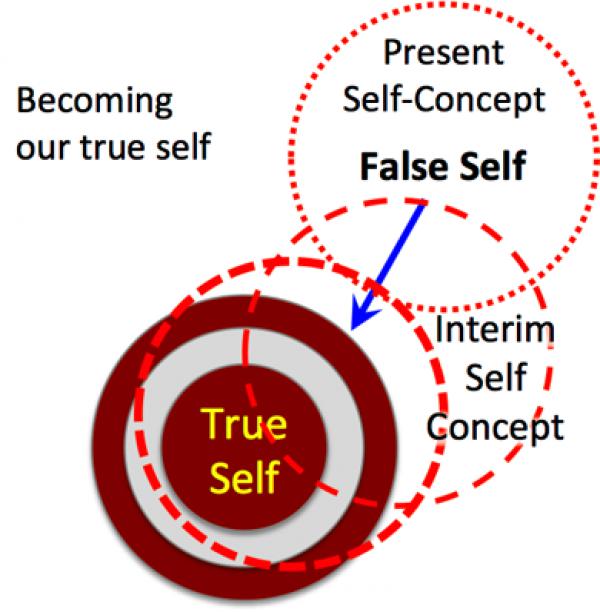
The self-identity we have today is not who we really are but a false self. We are a shadow of our true self. We were weakened by the Greater Serbian agenda and the Kingdom of Yugoslavia. We were broken by the social engineering of the socialist agenda in the communist Yugoslavia. Today, the opportunistic charlatans and quacks want to take advantage of us while we are in a weakened state.
Change does not mean becoming something we are not but becoming what we truly are. The change I recommend will bring us closer to our true self, our strong self, the self that can fight off the opportunists. The change we need is to ‘find ourselves’ and become who we truly are. Since the dawn of Croatian civilization we have been a strong and proud people. We built Croatia and it grew to be successful. Even after we became junior partners in local empires we were brave and we had integrity. 1,200 years of bravery and integrity is who we really are.
We are a strong people, a good people. While being successful warriors is not the only thing to strive for, the courage of a warrior is very important. While a small nation we were also a nation of explorers and adventurers requires courage and risk-taking.
Pope Leo X recognized the true Croatian identity when declared Croatia Antemuralis Christianitatis in 1519 for Croatia’s significant contributions to the struggle against the Ottoman advance into Europe which was eventually stopped in 1593 at the Battle of Sisak.
Napoleon saw the Croatian true self when he said to General Marmont: ‘I never had more braver and better soldiers’. Napoleon also said this: ‘Croatians, there are best soldiers in the world. If I had only 100,000 Croatians, I would conquer the entire world!’.
Not only were Croats brave soldiers they were also brave explorers and adventurers. Marco Polo (Marko Pilic from Korcula) is an ethnic Croat, Ragusa (Dubrovnik) was a maritime power that rivaled Venice and there were Ragusan Croats sailing with Columbus to the New World in 1492.
Let us not forget the spirit of the people captured in the motto of Ragusa / Dubrovnik:
Liberty is not sold for all the gold in the world
Sloboda se ne prodaje za sve zlato svijeta
Where to start
People whine when they have no control over their lives, their environment and their future. To stop the whining the people need to be empowered. 25 years ago Croatians were very active in creating an independent Homeland. It is time again that Croatians become active citizens.
The younger generation, those under 30, are naturally more individual than the older generation. We need to promote their individualism and their desire to accomplish something. We harm their natural individualism when we place them into outdated hierarchic structures where they just do what they are told. Rather than teach them to wait for permission we need to promote their desire to act.
We need psychologists and sociologists that can develop programs to empower the young generation. Empowering means that we give them responsibility, authority and accountability to achieve something. We need to fund active citizen programs but money is not enough. Youth need role models. Success will destroy the mindset of learned helplessness.
To empower people we need to give them control over something in their area of interest. Find people that are interested, better yet passionate about something and let them be active in their area of interest. Give them influence and some control. When people see that some citizens are empowered more people will be motivated to become active citizens and influence the public debate. Once people feel they have some influence and some control over their destiny they will never again want to be helpless and apathetic citizens. 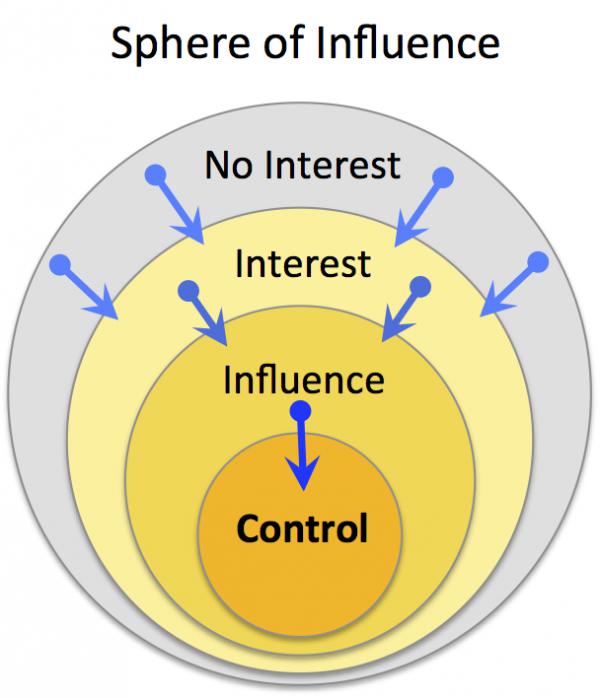
Being a part of the West
I hear, quite often, from Croatian political quacks that ‘this is Croatia, this is not Canada, your ideas will not work here’. Those are the words of a Balkanite / Balkanac.
A Canadian, a Croatian Canadian, would never accept the nature of Croatian government nor be a willing victim of blatant government corruption and incompetence. This is why the charlatans and quacks want to keep us out of Croatian society. We Canadians:
• Expect more
• Demand more
• Act more
Having a Western mindset and worldview means that we believe in rationalism, self-criticism, the disinterested search for truth, the separation of church and state, the rule of law, equality before the law, freedom of conscience and expression, human rights and representative democracy. We hold our politicians accountable. Being a part of the West means that we take individual responsibility rather than wait for collective solutions being given to us by a benevolent superior.
The Western mindset is not alien to Croats that live in Canada. Croatians prosper when they leave Croatia and settle in nations that value open-mindedness, reason and hard work. Croats that live in Canada are, on average, better off than the average Canadian. On average Croats are better educated, have better jobs and a better standard of living. These Croats are living proof that the Western mindset is not something incompatible with to Croatian ‘genetic programming’.
In the same way Croats succeed in Canada they succeed in the USA, Australia, Switzerland, Germany, Chile and Argentina. Croats only fail in the Homeland. Croatians are Croatians, no matter where they are in the world. What is different between the Homeland and the rest of the world is the culture and mindset.
Find a Role Model
Croatia has not been able to ‘figure it out’ for herself. Few people and few nations learn themselves how to be successful and wise nations learn from more successful nations. My recommendation is Croats to become students of success and find role models or mentors that we can learn from. A role model is an exemplar, someone good at what they do, that we can emulate. Willing to learn requires humility and that in itself is a big step out of the Balkans.
Two interesting countries that we can learn from are Latvia and Estonia. Both of these nations were behind the Iron Curtain and much closer to Moscow than was Croatia but today both of these nations have better rule of law, better economies and are more prosperous states than is Croatia. We could choose Sweden as a role mode but it would take maybe two or three generations to reach Sweden’s level of social capital and success, but achieving Estonia and Latvia’s level could be done in less than one generation and if we are committed maybe only a decade.
Both Estonia and Latvia have a much lower power distance in the relationship between the people and the government. I think that this is a good starting point for benchmarking and as a goal towards which we can start working.
Change requires taking action and risk. Everyone is naturally risk averse but some more than others. Being risk averse does keep you safe but extreme risk aversion can also lead to stagnation. We need to be willing to take more risks. 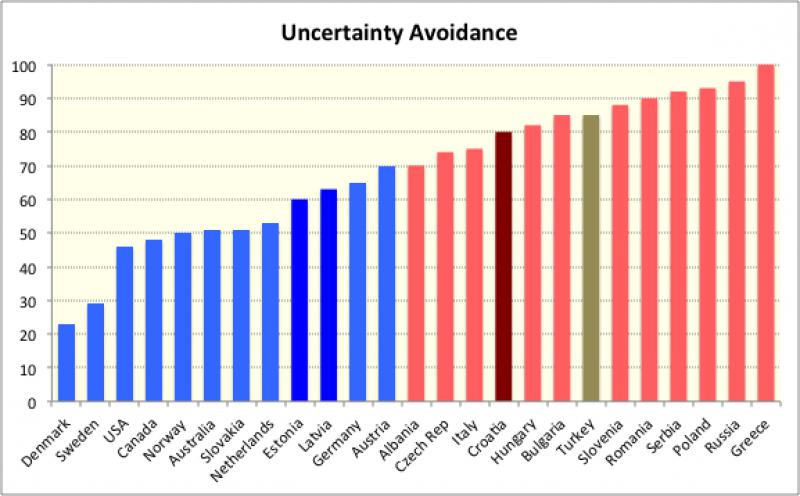
A person that has self-respect will stand up for himself. Increasing our individualism increases our self-confidence and self-responsibility. We need to be loyal to ourselves, our family and friends as well as to God, but loyalty can be abused. In no way should we be blindly loyal to a centralized political party or government. An individual with self-respect will hold those institutions accountable rather than fee obligated and accountable to the institutions. An individual keeps the system honest.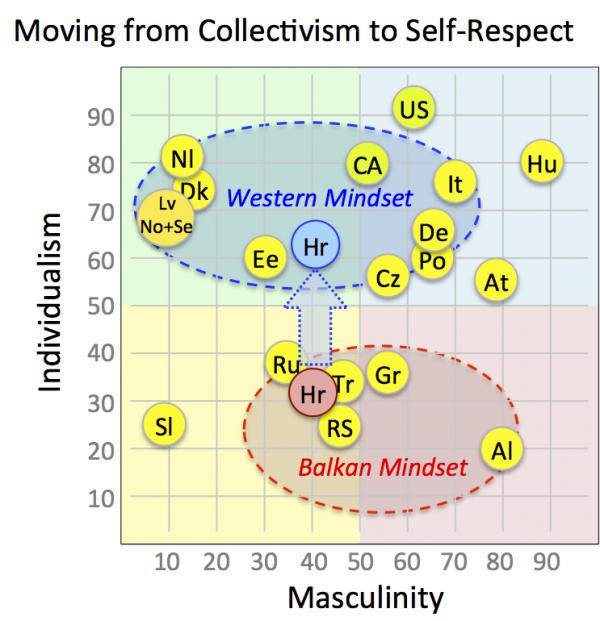
Source: Hofstede Centre
http://geert-hofstede.com/croatia.html
We do not need to make any changes in how masculine or feminine the nature of society is. The Scandinavian countries are very successful with a less competitive and more relationship based dynamic. In the Scandinavian countries the group is important and people know that they are a part of society and have to sacrifice a little and give a little for society to function properly but the individual is important and does not get submerged of lose identity or individualism in the group.
We need to stop following our Balkan role models. Being an irresponsible Balkanite might be fun, just like being an irresponsible teen is fun but sometime in life you need to grow up. To grow up means to take more responsibility and responsibility requires self-confidence, self-respect, willingness to take risks and an ability to do something. To be wise we can’t assume that the government will solve the problem with the government is the problem.
Higher individualism appears to have a good correlation to lower power distance and lower uncertainty avoidance. Higher individualism appears to be a good thing.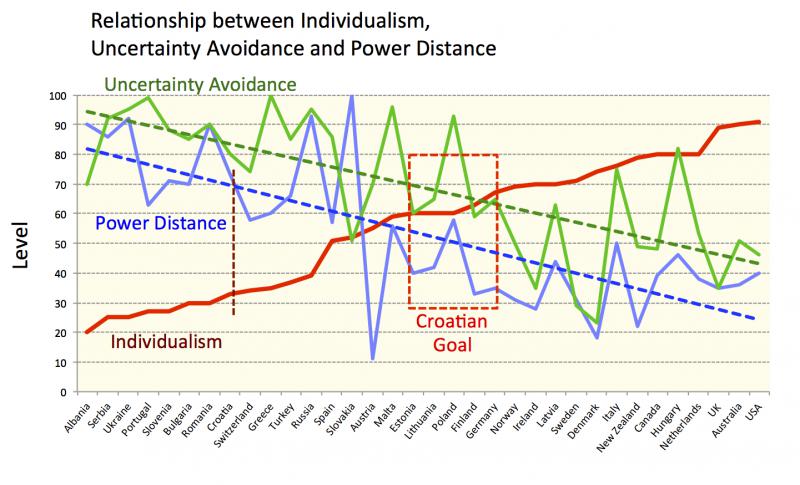
What we need for a modern Croatian mindset
Individualism is not selfishness.
Individualism is about respect and responsibility.
Develop self-respect. People that have self-respect stand up for themselves. Rather than just complain the citizens must become active and demand accountability from the government and all groups they are part of.
Live by the Golden Rule. We need to respect others in order to build a just society. We proclaim ourselves to be good Catholics but we quite often do not live by the Word of God. Balkanism is very self-centered powered by ego. Being unapologetic and stubborn is not a virtue and not compromising is not a strength.
Build unity. Political power comes from strength in numbers, coalitions and cooperation, not from manipulation. As long as we are divided and quarrel amongst ourselves, blue team against blue team, we will never beat the red team. The Balkan mindset is very tribal and exclusive; if you are not like me and with me then you are against me.
Be future oriented. We need a vision to fight for. The Balkan mindset focuses on what we are fighting against rather than what we are fighting for. We will never move forward by looking backwards. We need statesmen that focus on 2041 and how your grandchildren will live rather than quarrel about 1941 and what your grandfather did.
Broaden our perspective. It does not matter where a good idea comes from. There are good ideas in Canada, Australia, the USA, Germany, Argentina and Chile that we can bring home to Croatia and make our own. More humility and less arrogance are needed to develop the open mindset. A wise man learns from the successes and failures of others so that he does not have to learn solely on his own.
Active Citizens
No stream rises higher than its source. Whatever man might build could never express or reflect more than he was. He could record neither more nor less than he had learned of life when the buildings were built.
– Frank Lloyd Wright
In politics, like nature and Wright’s architecture philosophy, no government will rise above the level of the people that form and empower the government. If the people want a better government then the people must become better citizens.
A competent citizen knows his responsibilities and fulfills the obligations that come with citizenship. A good citizen does not abdicate his responsibilities. A good citizen does not blindly support political parties. A good citizen is an active citizen willing to be critical of his party and government. Incompetent citizens will never be a foundation for a competent state.
Active citizens take an interest in both being informed of the issues and actively contributing to the public debate in order to influence the decision making process. We Croats are very well informed about the problems and who is to blame but ignorant of how to solve the problems.
‘Great minds discuss ideas;
average minds discuss events;
small minds discuss people.’
– Eleanor Roosevelt
Only when the people take their responsibility of being active citizens seriously will competent people of good character be elected and the government act in a responsible and accountable manner. Active citizens can pull Croatia from the quagmire of the Balkan mindset. Incompetent and inactive citizens will keep Croatia in the Balkans. The charlatans want us to stay ignorant and helpless.
How the Diaspora can help
We, Diaspora Croats, want to help. Those of us that have been fortunate, whose families God guided out of the Homeland to see new things, experience new ways and learn new ideas, feel an obligation to help our brothers and sisters in the Homeland. We can be mentors and role models to help young people becoming their true self.
We in the Croatian Diaspora do not think we are smarter than anyone in Croatia, we just have different experiences and approaches to solving problems. We could help Croatia evolve 50 years in 10 years but we can do that only if our help is desired.
If Croatia is a modern part of the West it will ask for help, genuine help, from the global Croat community to bring new ideas home to make Croatia healthy again. The only people that feel threatened by us Global Croats are the Homeland charlatans because we see their quackery for what it is. The charlatans are afraid of losing their customers.
We have a sense of Croatian solidarity. The Jews, in global solidarity, were able to build a homeland from nothing in 30 years. The Balkan mindset and political quackery will turn a Croatia into nothing in 30 years if we do not change the course to destruction that we are on.
Does your leader understand gap analysis and change management?
Is your leader a charlatan, a quack or a professional? Ask your leader what their level of expertise is with change management and gap analysis. Ask about SWOT and benchmarking. Do they have any economists, psychologists or sociologists as part of the strategy development team? If they, or their team, does not have these skills they are quacks.

Doing a gap analysis (also known as need-gap analysis, needs analysis, and needs assessment) is not difficult, businesses and governments in the West use this tool all the time. Creating a vision and having the leadership skills to manage the changes required to attain the desired future state is something that is lacking.
A successful analysis required doing open-minded soul-searching to determine the root causes of the present situation, the ‘what is’ that we want to get out of and a vision to determine a viable future state, ‘what should be’. Once you know where you want to do you develop a roadmap. Leadership is required to get buy-in to take the steps necessary to reach the desired state.
Gap analysis forces a company, an organization or a government to seriously reflect of who it is and what it wants to be in the future. Has any Croatian leader that you know of carried out such an analysis and developed a change management program based on this sort of analysis? Should you follow a leader that has not done this?
Links
http://www.vojska.net/eng/history/france/napoleon/
http://www.newadvent.org/cathen/04510a.htm
Datum objave: 20.04.2015.